This article was originally published in Miffa.euA Requiem for the Masochist and the Rise of the “Performancer”
If you have spent enough time in the “business of running”—whether as a runner, a marketing mercenary, or some tragic hybrid of both—you have witnessed a deep, perhaps irreversible, transformation of the industry. For the uninitiated, allow us to summarize this evolution with a healthy pinch of salt and a splash of vinegar.

A Brief History of the Sole: 1950–2026
In the pages of a vintage luxury journal, one expects a sense of provenance. Running gear, once a humble tool, has become a high-stakes artifact of social signaling.
| Era | Shoe Materials (Sole/Midsole/Upper) | Benefit Desired | Main Brands | Textile Materials | Brand Communication Approach |
|---|---|---|---|---|---|
| 1950s – 1960s | Gum rubber / Leather / Canvas & Kangaroo leather | Traction, Durability, Weight reduction | Onitsuka Tiger, Adidas, New Balance | Cotton, Wool, Heavy Canvas | Utilitarian: Gear as “tools of the trade” for elite track athletes. Focus on Olympic glory. |
| 1970s – 1980s | Waffle rubber / EVA foam / Nylon & Suede | Shock absorption, Cushioning, Weight | Nike, Adidas, Brooks, Saucony | Early Synthetics, Mesh, Nylon | Democratic: The “Jogging Boom.” Health and wellness for the masses; “Just Do It” spirit. |
| 1990s – 2000s | Carbon rubber / Visible Air & Gel / Synthetic overlays | Motion control, Energy return, Stability | Asics, Mizuno, Nike, Reebok | Polyester, Lycra/Spandex, GORE-TEX | Hyper-Motivational: Aggressive athletic performance and visible technology; “Faster, Stronger.” |
| 2010s – 2018 | High-abrasion rubber / TPU (Boost) & PEBA / Knit uppers | Energy return, Natural feel, Max cushion | Hoka, Adidas, Nike, Saucony | Recycled Polyesters, Flyknit, Compression | Science-Based: Focus on data, marathon split times, and “marginal gains.” |
| 2019 – 2026 | Carbon plates / Ultra-responsive foams / Ultra-thin mesh & Translucent mono-mesh | “The Functional Alibi”: High-sounding performance justifying luxury pricing | Satisfy, District Vision, Bandit, Optimistic Runners | Trademarked fabrics: Justice™, PeaceShell™, GhostFleece™, and distressed “MothTech” cotton | “Anti-Athletic” Tone: Rejection of legacy hyper-motivation; focus on the “High,” mindfulness, and running as an “esoteric art movement”. |
The Great Pivot: From Masochist to Actor
Modern running has successfully divorced itself from traditional athletic goals. The sport has transitioned from a form of “physical masochism” into a “playground of lifestyle curation and social status”.
We now see a divide between the “Performer” and the “Performancer”. While the former still chases a PR, the latter is an actor—a global star in need of social success in every activity. Running is no longer just about the visceral sting of sweat; it is about self-expression and “intellectual minimalism”. Running has become the “New Golf,” and its leaders are no longer Olympians, but the “cultural leaders”—DJs, chefs, designers, and the occasional billionaire seeking a curated life.
The Brands Are Not Your Friends
Let us be clear: the aggressive messaging of legacy brands—convincing you there were no limits and that you were essentially an elite athlete in disguise—were, for the most part, plain lies. While some technologies, like carbon plates and ultra-responsive foams, provided genuine performance revolutions, they were often used to sell a dream that most could never inhabit.
Meanwhile, the luxury market evolved, sparked by social media and a new desire for tribal belonging. Luxury used to be about the artisan: a Goyard travel trunk hand-stitched for those who actually had the time to travel. Then came the Prêt-à-porter epoch, and eventually, the “emerging market” shift where design was tailored to whoever had the most money.
Today, they don’t care about quality; they care about scarcity. The “limited run” and the “drop” are the new religions. They raise the price not because the materials are better, but to make the item feel “more premium”.
Understanding the “Functional Alibi”
How do these brands—the old ones who were never your friends and the new ones who are even more interested in your wallet—profit from this fashion? They use the “Functional Alibi”.
This is high-sounding technical performance used to justify luxury pricing for items that are primarily aesthetic.
- The “MothTech” Lesson: Consider the strategy of selling distressed, “ruined” cotton tees for over $140 by marketing the holes as “scientific heat-mapping”.
- Proprietary Nomenclature: Brands use trademarked names like Justice™, PeaceShell™, or GhostFleece™ to provide a “rational justification for a highly irrational luxury purchase”.
A Restoration of Karma
We are here to help, and truly, it won’t cost you a dime.
After decades of inside work—studying human cognitive faults to increase sales, using language to manipulate, and living on the verge of the “overpromise”—we are looking to restore a bit of karma. We have spent years in the “marginal gains” battle, convincing people to spend fortunes on ultra-expensive Toray 7000 Carbon fiber or hand-stitched leather backpacks.
We have nothing against the “fake runner” or the “poser”—fashion is, after all, personal and based entirely on perception.
But in our next dispatch, we will show you how to navigate this world of artifice with your dignity and your bank account intact.
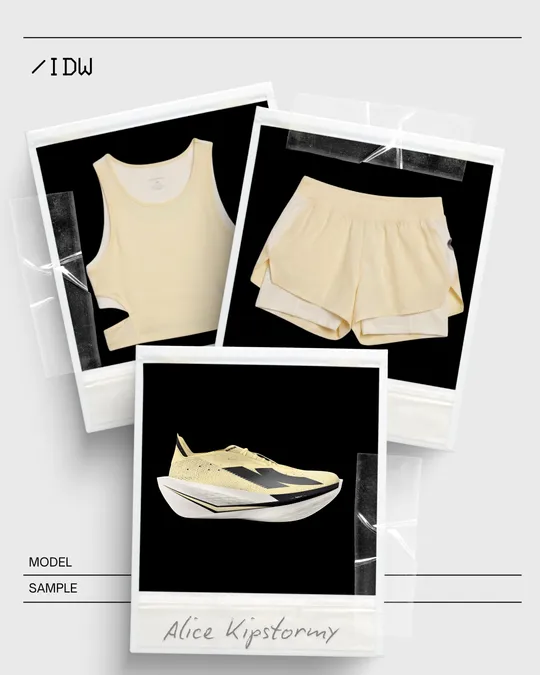
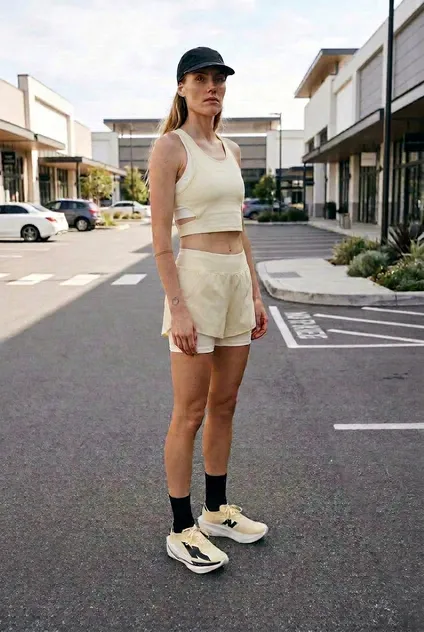
This styling is luxury performance minimalism where the palette is doing most of the storytelling. Acontemporary women’s running story positioned between sport and luxury ready-to-wear: restrained, tonal, technical, and highly marketable.
The vanilla + ivory pairing feels refined, tonal, and modern. It gives the outfit a soft performance identity, more lifestyle-luxury than race-day utility
Vanilla is the hero tone: soft, creamy, elevated, less aggressive than optic white, more fashion-forward than beige. Ivory white adds technical purity and a clean athletic base. Black accents in the cap, socks, and shoe logo create graphic tension and sharpen the look